Changing tires
A vehicle can slip or roll off of a jack causing serious injury or death to you or those nearby. Take the following safety precautions:
-
NEVER place any portion of your body under the vehicle that is supported by a jack.
-
NEVER attempt to change a tire in the lane of traffic. ALWAYS move the vehicle completely off the road on a level, firm ground away from traffic before trying to change a tire. If you cannot find a level, firm place off the road, call a towing service for assistance.
-
ONLY use the jack provided with the vehicle.
-
ALWAYS place the jack on the designated jacking positions on the vehicle and NEVER on the bumpers or any other part of the vehicle for jacking support.
-
Do not start or run the engine while the vehicle is on the jack.
-
Do not allow anyone to remain in the vehicle while it is on the jack.
-
Keep children away from the road and the vehicle.
Follow these steps to change your vehicle's tire:
-
Park on a level, firm surface.
-
Shift the gear to P (Park), apply the parking brake, and press the Engine Start/Stop button to the OFF position.
-
Press the hazard warning flasher button.
-
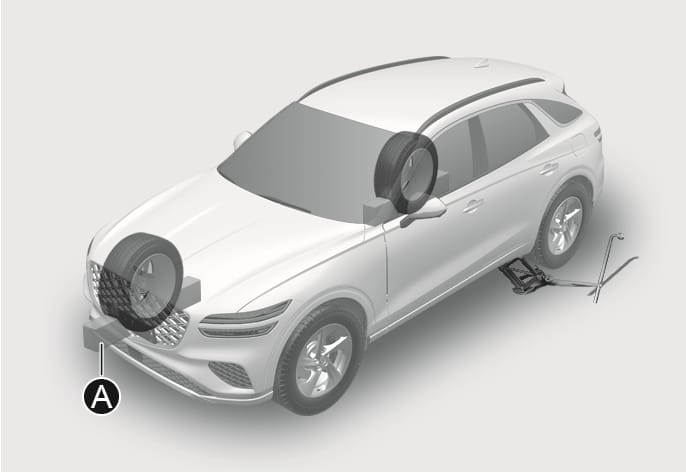
Remove the wheel lug wrench, jack, jack handle, and spare tire from the vehicle.
-
Block both the front and rear of the tire diagonally opposite of the tire you are changing.
2C_JackHandle
- Block
-
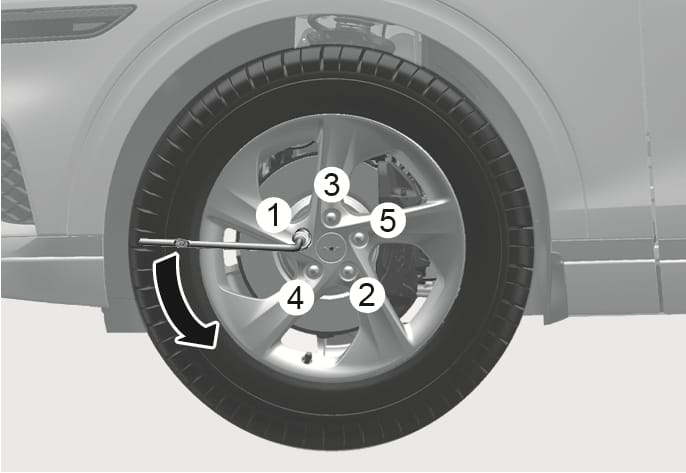
Loosen the wheel bolts counterclockwise one turn each in the order shown below, but do not remove any wheel bolts until the tire has been raised off of the ground.
2C_SpareTire
-
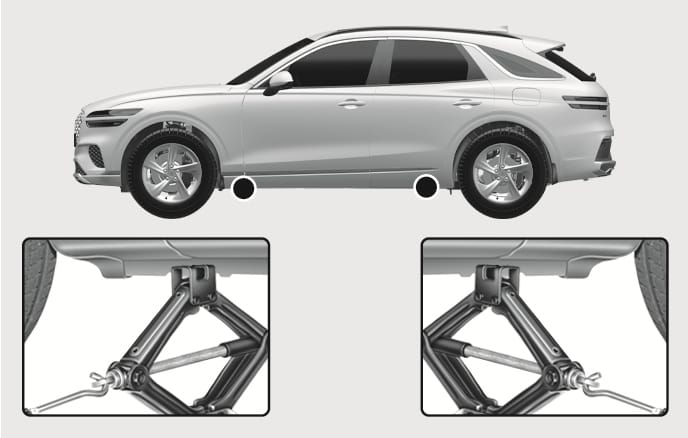
Place the jack at the designated jacking position under the frame closest to the tire you are changing. The jacking positions are plates welded to the frame with two notches. Never jack at any other position or part of the vehicle to prevent the vehicle slipping off of the jack or damaging the vehicle.
2C_JackHandle_1
-
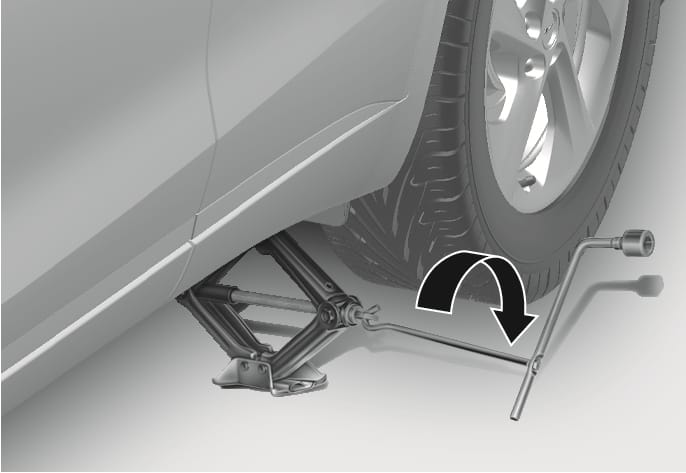
Insert the jack handle into the jack and turn it clockwise, raising the vehicle until the tire clears the ground. Make sure the vehicle is stable on the jack.
2C_JackHandle_2
-
Loosen a wheel bolt with the wheel lug wrench and remove it with your fingers.
-
Insert the centering pin (1) into the hole where the wheel bolt is removed. Remove the rest of the wheel bolts from the wheel.
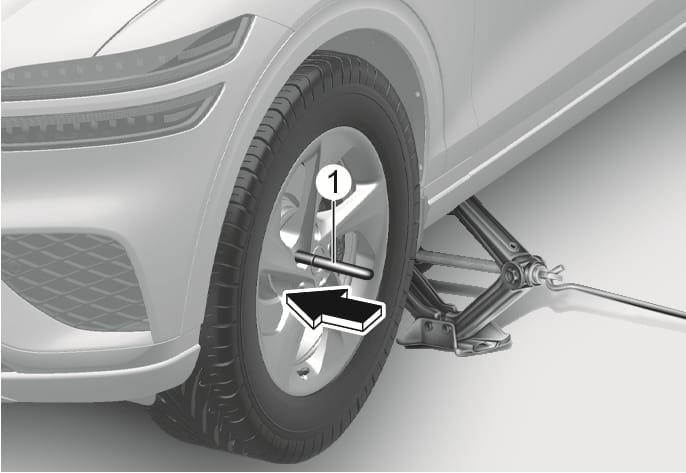
2C_JackHandle_3
-
Remove the wheel from the studs and lay it flat on the ground out of the way. Remove any dirt or debris from the studs, mounting surfaces, and spare tire.
-
Install the spare tire over the centering pin (1) and then push in the spare tire.
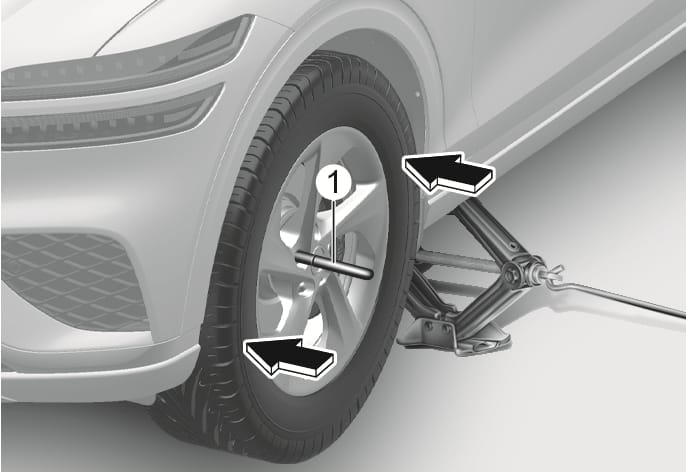
2C_JackHandle_4
-
Tighten the wheel bolts with your fingers onto the studs with the smaller end of the wheel bolts closest to the wheel.
-
Pull out the centering pin (1) and tighten the last wheel bolt.
-
Lower the vehicle to the ground by turning the jack handle counterclockwise.
-
Use the wheel lug wrench to tighten the wheel bolts in the order shown. Double-check each wheel bolts until they are tight. After changing tires, we recommend that an authorized retailer of Genesis Branded products tighten the wheel bolts to their proper torque as soon as possible. Tighten the wheel bolts to 14-16 kgf·m (101-116 lbf·ft).
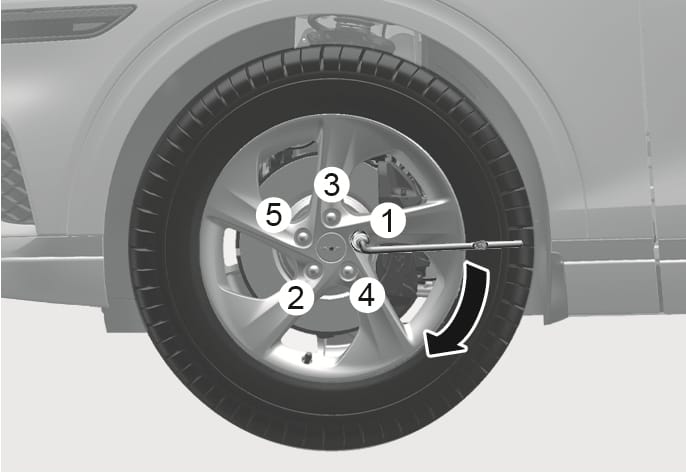
2C_JackHandle_5
Check the tire pressure after installing the compact spare tire. The compact spare tire should be inflated to 420 kPa (60 psi).
If you have a tire gauge, check the spare tire pressure (refer to the "Tires and wheels" section in chapter 2 for tire pressure instructions.). If the spare tire pressure is lower or higher than the recommended, drive slowly to the nearest service station and adjust it to the recommended pressure. Always reinstall the valve cap after checking or adjusting the tire pressure. If the cap is not replaced, air may leak from the tire. If you lose a valve cap, buy another and install it as soon as possible. After changing tires, secure the flat tire and return the jack and tools to their proper storage locations.
Check the tire pressure as soon as possible after installing a spare tire. Adjust it to the recommended pressure.
Your vehicle has metric threads on the studs and wheel bolts. During tire changing, make sure that the wheel bolts that were removed are reinstalled. If you have to replace your wheel bolts, make sure they have metric threads to avoid damaging the studs and make sure the wheel is properly secured to the hub. We recommend that you contact an authorized retailer of Genesis Branded products for assistance.
If any of the equipment such as jack, wheel bolts, studs, or other equipment is damaged or in poor condition, do not attempt to change the tire and call for assistance.
Compact spare tires are designed for emergency use only. Drive carefully on the compact spare tire and always follow the safety precautions.
To prevent compact spare tire failure and loss of control, possibly resulting in a collision:
-
Use the compact spare tire only in an emergency.
-
NEVER operate your vehicle over 80 km/h (50 mph).
-
Do not exceed the vehicle's maximum load rating or the load carrying capacity shown on the sidewall of the compact spare tire.
-
Do not use the compact spare tire continuously. Repair or replace the original tire as soon as possible to avoid failure of the compact spare tire.
When driving with the compact spare tire mounted to your vehicle:
-
Do not take this vehicle through an automatic car wash after the compact spare tire has been installed.
-
Do not use the compact spare tire on any other vehicle because this tire has been designed especially for your vehicle.
-
The compact spare tire's tread life is shorter than a regular tire. Inspect your compact spare tire regularly and replace worn compact spare tires with the same size and design, mounted on the same wheel.
-
Do not use more than one compact spare tire at a time.
-
Do not tow a trailer while the compact spare tire is installed.
When the original tire and wheel are repaired and reinstalled on the vehicle, the wheel bolt torque must be set correctly. The correct wheel bolt tightening torque is 14-16 kgf·m (101-116 lbf·ft).
To prevent damaging the compact spare tire and your vehicle:
-
Drive slowly enough for the road conditions to avoid all hazards, such as a potholes or debris.
-
Avoid driving over obstacles. The compact spare tire diameter is smaller than the diameter of a conventional tire and reduces the ground clearance about 25 mm (1 in.).
-
Do not use tire chains on the compact spare tire. Because of the smaller size, a tire chain will not fit properly.
-
Do not use the compact spare tire on any other wheels, nor should standard tires, snow tires, wheel covers or trim rings be used with the compact spare wheel.
-
Do not suddenly accelerate or decelerate 0-40 km/h (0-25 mph) in any driving mode. Transfer case oil may leak.