All Wheel Drive (AWD) operation
If the AWD system determines there is a need for four wheel drive, the engine's driving power is distributed to all four wheels automatically.
In the multi terrain mode, four-wheel drive, engine, transmission, braking and electronic limited slip differential is controlled to achieve optimal driving performance depending on the mode selected (SNOW/MUD/SAND).
2C_TerrainModeButton_1
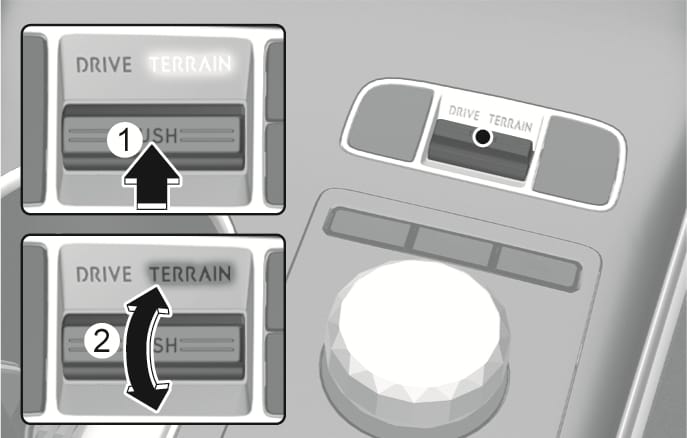
Press the DRIVE/TERRAIN switch (1) to change from normal driving mode to multi terrain mode. After the switch is pressed, push the switch up or down (2) within 4 seconds to select SNOW, MUD, or SAND.
|
Selected mode |
Description |
|
|
COMFORT, ECO, SPORT |
|
|
|
SNOW |
|
|
|
MUD |
|
|
|
SAND |
|
|
-
Use Auto AWD mode when driving on normal roads.
-
Driving on normal roads with the Multi Terrain mode on, especially when cornering may cause mechanical noise or vibration. Driving in this mode for prolonged periods may damage parts of the power train. The noise and vibration disappear when the Multi Terrain mode is deactivated.
When the mode is switched from Multi Terrain to Auto AWD, a sensation may be felt as the driving power is delivered entirely to the front wheels.
If the AWD (
Before driving
Make sure all passengers always wear their seat belts.
Driving on snow-covered or icy roads
-
Start off slowly by applying the accelerator pedal gently.
-
Use snow tyres or tyre chains.
-
Keep a sufficient distance between your vehicle and the vehicle in front.
-
Use engine braking during deceleration.
-
Avoid speeding, rapid acceleration, sudden brake applications, and sharp turns to prevent skids.
-
When using snow tyres, mount them on all four wheels.
-
When using tyre chains, install them on the rear tyres. However, driving speed must be below 30 km/h and minimise the driving distance. High-speed or long-term driving with the chains installed may malfunction or damage the AWD system.
For more information on Snow tyres and Tyre Chains, refer to the "Winter driving" section later in this chapter.
Driving in sand or mud
-
Maintain slow and constant speeds.
-
Use tyre chains when driving in mud if necessary.
-
Keep sufficient distance between your vehicle and the vehicle in front.
-
Reduce the vehicle speed and always check the road condition.
-
Avoid speeding, rapid acceleration, sudden brake applications, and sharp turns to prevent getting stuck.
When the vehicle is stuck in snow, sand, or mud, place a nonslip material under the drive wheels to provide traction OR slowly spin the wheels in forward and reverse causing a rocking motion that may free the vehicle.
Avoid running the engine continuously at high RPM to prevent damage to the AWD system.
Driving up or down hills
-
Driving uphill
-
Before starting off, check if it is possible to drive uphill.
-
Drive as straight as possible.
-
-
Driving downhill
-
Do not change gears whilst driving downhill. Select a gear before driving downhill.
-
Drive slowly when using engine braking whilst driving downhill.
-
Drive straight as possible.
-
-
Exercise extreme caution driving up or down steep hills. The vehicle may roll over on the gradient, terrain, and water/mud conditions.
-
Do not drive across the contour of steep hills. A slight change in the wheel angle may destabilize the vehicle. A stable vehicle may lose stability if the vehicle stops its forward motion. Your vehicle may roll over, resulting in a serious injury or death.
Driving through water
-
Try to avoid driving in deep standing water. It may stall your engine and clog your exhaust pipes.
-
If you need to drive in water, stop your vehicle, set the vehicle in Multi Terrain mode, and drive below 8 km/h.
-
Do not change gears whilst driving in water.
Additional driving conditions
-
Become familiar with the off-road conditions before driving.
-
Always pay attention when driving off-road and avoid dangerous areas.
-
Drive slowly when driving in heavy wind.
-
Reduce vehicle speed when cornering. The centre of gravity of AWD vehicles is higher than conventional 2WD vehicles. The vehicle is more likely to roll over if you turn the steering wheel too quickly.
-
Always hold the steering wheel firmly when you are driving off-road.
Do not grab the inside of the steering wheel when you are driving off-road. You may hurt your arm by a sudden steering manoeuvre or from steering wheel rebound due to an impact with objects on the ground. You may lose control of the steering wheel that may lead to serious injury or death.